

How Deworming Quietly Stopped Working
For decades the advice was simple: deworm every horse, every few months, and rotate the brands. It made sense at the time. It was also the fastest way to breed worms that no dewormer can touch.
That is no longer a warning about the future. It is the situation on a large number of yards today. There are four anthelmintic drug classes available to horses, no new one has come to market in over forty years, and resistance to all of them has now been documented in peer reviewed studies (Nielsen et al., 2025). The tools you have are the tools you will have. How long they keep working depends entirely on how you use them.
The problem with treating every horse
The instinct to treat the whole yard on a calendar comes from a reasonable place. If worms are bad, treat for worms. But two facts about how strongyles actually behave turn that instinct into a liability.
The first is that shedding is not evenly spread. In any group of horses, roughly 20% shed around 80% of the eggs (Kaplan and Nielsen, 2010). A small number of horses do most of the pasture contamination, and the rest carry burdens that were never a real threat.
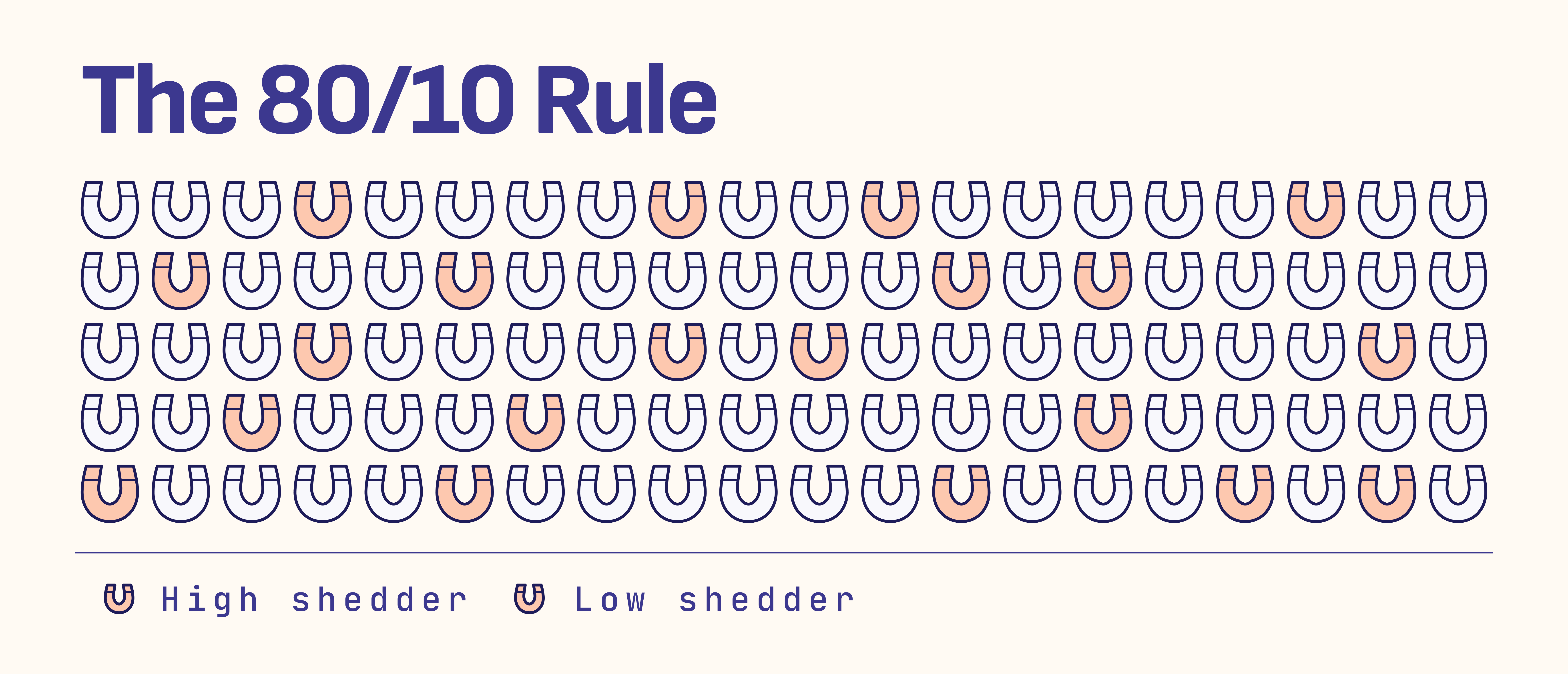 20% of horses shed 80% of eggs
The second is that this pattern is stable. A horse that sheds low tends to keep shedding low over years, and a high shedder tends to stay high (Nielsen et al., 2006). A horse's status is not a coin toss you have to re treat blindly. It is a known quantity, once you have measured it.
Put those together and calendar deworming does two damaging things at once. It doses horses that were never the problem, and every one of those unnecessary doses gives the surviving worms another chance to select for resistance. You spend money and drug efficacy to make the situation worse.
What replaced it
Every major guideline published in the last decade, from the American Association of Equine Practitioners to the European ESCCAP guideline, now recommends the same surveillance based approach (Nielsen et al., 2025). It runs in three steps.
Count first. A fecal egg count tells you which horses are actually shedding before a single dose is given. It is worth being precise about what this number means. The count reflects egg output, not the size of the worm burden inside the horse, and it is not a diagnostic tool for a sick animal (AAEP, 2024). Think of it as a pasture contamination meter, not a health readout. Horses are commonly classed as low shedders below 200 eggs per gram, moderate between 200 and 500, and high above 500 (AAEP, 2024).
Then target. Treat the horses that need it and leave the rest. The efficiency here is striking. Treating only horses above the 200 egg per gram threshold means dosing roughly half the population while still removing around 95% of the total egg output (Kaplan and Nielsen, 2010). Fewer doses, better control, and the surviving susceptible worms act as a reservoir that slows resistance.
Then check the drug still works. This is the step most yards skip, and it is the one that matters most for the years ahead. A fecal egg count reduction test compares counts before treatment and again fourteen days after, across a group of horses, to confirm the dewormer is doing its job (Kaplan et al., 2023). Resistance is invisible until you measure it. The warning signs are already here: the period before eggs reappear after an ivermectin dose has fallen from eight to ten weeks in the 1990s to four or five weeks now, and moxidectin has fallen from twelve to sixteen weeks to the same four or five (Nielsen, 2022).
Where it gets more nuanced
Two caveats keep this from being a blanket rule. Foals and youngsters are the exception. Selective treatment based on counts is not recommended for them, because their parasite picture changes too quickly and ascarids carry real risk (AAEP, 2024). And in regions with tight restrictions on when dewormers can be used, the dangerous bloodworm Strongylus vulgaris has re appeared, which is why ESCCAP recommends annual screening for it on farms that have moved to selective treatment (Nielsen et al., 2025). Testing less is not the same as testing nothing.
The shift is not really about doing more. It is about doing the right thing to the right horse, and knowing, rather than assuming, that it worked.
Excellence behind the scenes. Performance in the arena.
Sources
- AAEP (2024). Internal Parasite Control Guidelines. American Association of Equine Practitioners. aaep.org
- ESCCAP. Guideline 08: A Guide to the Treatment and Control of Equine Gastrointestinal Parasite Infections. European Scientific Counsel Companion Animal Parasites. esccap.org/guidelines/gl8
- Kaplan, R.M. and Nielsen, M.K. (2010). An evidence based approach to equine parasite control: it ain't the 60s anymore. Equine Veterinary Education 22, 306–316.
- Kaplan, R.M. et al. (2023). WAAVP guidelines for diagnosing anthelmintic resistance using the faecal egg count reduction test in ruminants, horses and swine. Veterinary Parasitology 318, 109936. Online efficacy calculator: fecrt.com
- Nielsen, M.K. (2022). Parasite faecal egg counts in equine veterinary practice. Equine Veterinary Education 34, 584–591.
- Nielsen, M.K. et al. (2025). Global equine parasite control guidelines: Consensus or confusion? International Journal for Parasitology: Drugs and Drug Resistance 28, 100600.